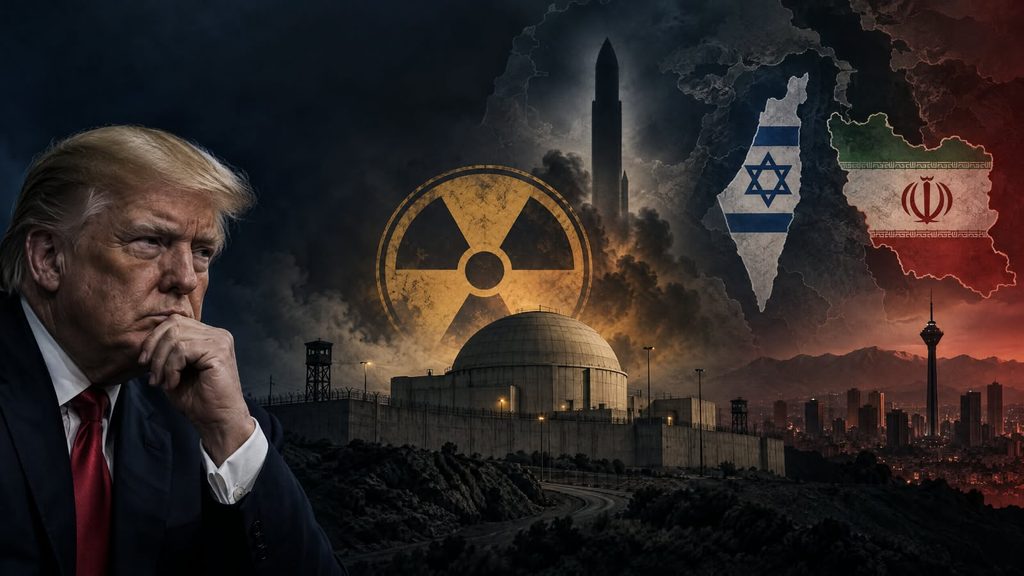
How did the “nuclear bomb” story spread?
In recent days, posts and videos circulating on social media have claimed that Trump and Netanyahu want to launch a nuclear strike against Iran. Some of these posts refer to statements about the need to destroy Iranian nuclear facilities and repeated American and Israeli threats. They then make a much more dramatic leap: that the use of a nuclear weapon is now imminent.
That conclusion is not supported by the reports that can be independently checked. Credible news organizations have reported on military options, airstrikes, and possible attacks on facilities linked to Iran’s nuclear program. They have not published evidence of authorization to use a nuclear weapon or of nuclear weapons being moved into the theater of operations.
It is important to distinguish between three different possibilities: a conventional strike against a nuclear facility, the use of a conventional bunker-busting bomb, and the use of a nuclear weapon. Confusing these categories turns a dangerous military debate into a more sensational—but less accurate—rumor.
What do we know about Trump’s and Netanyahu’s positions?
Reuters reported on November 2 that Trump expressed doubts about resuming attacks on Iran. He told reporters that he was not considering a strike after the midterm elections, while also insisting that Washington would not allow Iran to possess a nuclear weapon and that a deal with Tehran remained possible.
In a November 1 report, Axios cited American and Israeli sources as saying that Netanyahu was pressing Trump to take military action after the elections, while Trump preferred, at that stage, to give negotiations more time. The report said Trump had discussed the possibility of targeting a heavily fortified nuclear site, but it did not report any decision to use a nuclear weapon.
These developments point to a dual-track pressure strategy: keeping the military option on the table to pressure Iran while leaving the door open to negotiations. The conflicting public statements may sound like preparation for a full-scale war, but they do not by themselves prove that a nuclear decision has been made.
The latest strikes: real escalation, but not a nuclear attack
On November 3, PBS NewsHour reported that the United States carried out limited strikes against Iranian targets on Qeshm and Hengam islands and near Bandar Abbas in the Strait of Hormuz. Citing a U.S. official, the report said the strikes targeted Iranians using surface-to-air missiles against American forces. Iranian media reported explosions in the area.
BBC Arabic also reported explosions in Hormozgan Province and quoted Iranian Foreign Minister Abbas Araghchi as warning that choosing war over diplomacy could lead to a “strategic defeat” for the United States. The report said Iran had placed its forces at a high level of defensive readiness.
These developments show that the risk of conventional military escalation is real. They do not mean that a nuclear weapon has been used or that a decision to use one has been made. Even in the most tense scenarios, there is a significant political, military, and legal gap between discussing an attack on a nuclear facility and using a nuclear weapon.
Why does talk about Iran’s nuclear program not prove that it has a bomb?
Iran’s nuclear program is at the center of the dispute. According to an October report by Euronews Arabic, Iran possessed a large stockpile of uranium enriched to as much as 60 percent before the strikes. However, high-level enrichment does not automatically mean that Iran possesses a ready-to-use nuclear bomb. Producing a usable weapon would require additional steps, including weapon design, assembly, and a delivery system.
The situation has also become more difficult to assess because International Atomic Energy Agency inspectors have been unable to fully verify the condition of some facilities and nuclear materials after the attacks. A report by the Arms Control Association said that the IAEA could not verify the status of certain facilities and associated nuclear material, while Iran linked the resumption of inspections to a broader diplomatic agreement.
This uncertainty fuels speculation from both sides. Israel and the United States warn that Iran could move closer to weaponization, while Tehran insists that its program is peaceful and rejects the accusations. But incomplete verification is not proof that a bomb is being built. Likewise, possessing enriched material alone does not prove the existence of a completed nuclear weapon.
How has Iran responded?
Iran’s response has unfolded on two levels. The first is military. Tehran has raised its state of readiness and warned that any new attack would face a stronger response. PBS NewsHour quoted Iranian Parliament Speaker and negotiator Mohammad Bagher Ghalibaf as saying that the ball was in Washington’s court to prevent war. He warned that any “strategic miscalculation” could open a new front.
The second level is diplomatic. Qatari mediators and other intermediaries have continued working toward an arrangement that could halt attacks in the Strait of Hormuz and pave the way for renewed nuclear talks. Reports say Tehran is demanding an end to military operations, the lifting of restrictions on its ports, and relief for its oil exports before returning to stable negotiations.
Iran is therefore trying to combine deterrence with diplomatic pressure: demonstrating that war would be costly while avoiding a complete closure of the negotiating channel. At the same time, the escalation has encouraged some voices inside Iran to call for a review of cooperation with the IAEA or even withdrawal from the Nuclear Non-Proliferation Treaty. Such steps could make the crisis even more difficult to resolve.
What are Russia and China saying?
Russia and China have condemned previous U.S. and Israeli strikes against Iran and called for an end to military operations and a return to dialogue. Chinese Foreign Minister Wang Yi said that attacks against a sovereign state and attempts to impose regime change were unacceptable. Russian Foreign Minister Sergey Lavrov said the strikes undermined stability in the Middle East.
The Russian and Chinese positions do not necessarily mean that the two countries endorse every Iranian position. Both governments say that the security of Gulf states must be respected and that the war must not spread. At the same time, they use the crisis to oppose unilateral military action outside the United Nations framework and what they describe as the politicization of the nuclear issue.
The IAEA Board of Governors referred Iran’s alleged non-compliance with its safeguards obligations to the U.N. Security Council in September, according to the Arms Control Association. Russia and China voted against the decision, reflecting the international divide over how to deal with Iran’s nuclear program.
What about the United Nations and Europe?
The United Nations and European governments generally emphasize two goals at the same time: preventing Iran from acquiring nuclear weapons and preventing military action from producing a wider regional war. European Union countries have called for restraint and respect for international law while supporting diplomatic efforts and regional mediation.
The difficulty is that international positions are caught between two apparently competing principles. There is a desire to prevent nuclear proliferation, but attacks on nuclear facilities could increase the risks rather than eliminate them. Such strikes could lead to the concealment of nuclear materials, reduced cooperation with inspectors, or stronger support inside Iran for the argument that nuclear weapons are the only reliable means of deterrence.
Could the rumor become reality?
A further conventional escalation cannot be ruled out, particularly while strikes, military deployments, and threats continue. But the use of a nuclear weapon would be a historic escalation whose consequences would extend far beyond Iran, Israel, and the United States. It could produce a humanitarian, environmental, and political catastrophe across the Middle East and beyond.
So far, the publicly available evidence does not indicate that the United States or Israel has decided to use a nuclear bomb. The more accurate description is that there is an escalating military confrontation and a debate over attacks on nuclear facilities, not a confirmed or publicly announced nuclear plan.
This is why sensational headlines should be treated with caution. A report saying that officials discussed “options against a nuclear facility” does not prove that they discussed a “nuclear bomb.” Likewise, a video on social media does not become an official document simply because it has received millions of views.
Conclusion
The current situation is dangerous, but it is more complicated than the claim that “Trump and Netanyahu are preparing to strike Iran with a nuclear bomb.” What is confirmed is an expanding military and political confrontation over Iran’s nuclear program, Israeli pressure for tougher options, an American policy that moves between pressure and negotiations, and an Iranian response combining deterrence with diplomatic outreach.
The claim that a decision to use nuclear weapons has been made is not supported by credible sources at this point. The most realistic way to prevent the worst outcome is to restore negotiations, enable the IAEA to conduct meaningful verification, and halt the attacks that make every side more rigid and less willing to compromise.
Suggested keywords: Trump and Iran, Netanyahu and Iran, nuclear bomb, Iranian nuclear program, U.S.-Israeli war, Iran’s response, Russia and China, Strait of Hormuz.
Suggested meta description: A fact-checked analysis of rumors that Trump and Netanyahu want to strike Iran with a nuclear bomb, examining what reports confirm about the military escalation, Iran’s response, and the positions of Russia, China, the United Nations, and Europe.
References
- Trump raises doubts about renewed attacks on Iran — Reuters
- [2] Trump has frank call with Netanyahu about next move in Iran war — Axios
- [3] U.S. launches new attacks on Iranian targets — PBS NewsHour
- [4] Explosions reported in Iran as Netanyahu insists on regime change — BBC Arabic
- [5] Is Iran approaching a nuclear bomb? — Euronews Arabic
- [6] IAEA Reports Iran to UN Security Council — Arms Control Association
- [7] China condemns attacks on Iran, urges ceasefire and talks — Reuters
- [8] Tracking Chinese and Russian Statements on the Iran War — The Washington Institute
- [9] EU nations call for maximum restraint and respect for international law — Reuters